REVIEW · SAVANNAH
Private Walking Tour of Historic Savannah
Book on Viator →Operated by Explore Savannah · Bookable on Viator
Savannah turns history into something you can actually walk through. This private 2-hour tour strings together the city’s key squares, big-story moments, and pop-culture stops. You get a local guide who can steer the focus, plus built-in chances for coffee and snacks.
I especially like the way the route stays simple and readable. It links major landmarks—Wright Square, Chippewa Square, and Forsyth Park—so you don’t just see pretty places, you get the why behind the layout and monuments.
One thing to consider: a couple of recent groups noted the guide was hard to hear when the pace and volume weren’t working well. If you’re in a bigger private group or prefer louder explanations, you’ll want to make sure you can hear clearly from where you stand.
In This Review
- Key Highlights You’ll Feel Right Away
- Wright Square: Starting Savannah with Oglethorpe and the Bluff Idea
- Juliette Gordon Low Birthplace: Girl Scouts History Without the Museum Detour
- Independent Presbyterian Church: Steeple, Fires, Hurricanes, and a Presidential Wedding
- Chippewa Square and the Forrest Gump Bench Scene: Pop Culture with Local Meaning
- Sorrel Weed House: Gray Brick Wall, Fingerprints, and a Haunted Reputation
- Madison Square: Siege of Savannah and Revolutionary Hard Edges
- Green-Meldrim House: Gothic Architecture and Sherman’s March to the Sea
- SCAD’s Volunteer Guard Building Pass-By: A Quick Look at Repurposed Space
- Gryphon Tea Room: Lunch Break Energy in a Building with Medicine Cabinets
- Mercer Williams House Museum: Midnight in the Garden of Good & Evil
- Armstrong House: Armstrong-Kessler WOW Factor, But No Inside Access
- Forsyth Park Finale: The Fountain That Started as a France Mail Order
- Pace, Comfort Stops, and How to Plan Around Weather
- Customization Options: Civil War Focus and Built-In Food Breaks
- Guides: Expect Fun and Clear Storytelling (Especially When You Can Hear Them)
- Should You Book This Private Savannah Walking Tour?
- FAQ
- How long is the Savannah private walking tour?
- Where does the tour start and end?
- Is the tour private?
- Is the tour offered in English?
- Do you go inside the Juliette Gordon Low Birthplace house?
- Are there admission tickets at the stops?
- What should I bring for walking in Savannah?
Key Highlights You’ll Feel Right Away
- Private, local-guided pace that lets your group move together for about 2 hours
- Movie and book connections including the Forrest Gump bench scene and the Midnight in the Garden of Good & Evil house
- Central Savannah squares explained with the original design logic, not just names
- Haunting details on the Sorrel Weed House plus that gray brick wall mystery
- Forsyth Park finale with the fountain’s origin story (including the France mail-order angle)
- Food and comfort breaks for coffee and snacks along the way
Wright Square: Starting Savannah with Oglethorpe and the Bluff Idea
Your tour begins at Wright Square in front of the Gordon Monument, on the north side of the square. This is a smart starting point because it gives you the city’s “operating system” early. I like it when a guide explains not only what happened, but how Savannah’s layout grew from a plan.
You’ll learn why General James Oglethorpe chose to establish the colony on a 40-foot bluff. That single detail changes how you picture Savannah’s early priorities—water, defense, and a practical view of the area. You also get the basics of how the city started: who had influence, how the settlement took shape, and how the squares fit into that plan.
The square also pulls in a couple of names that you’ll keep hearing throughout Savannah. Tomochichi, the chief of the Yamacraw Indians, is tied to this opening story and you’ll learn why he’s associated with the Gordon Monument area. And yes, you get the port fact too: the Port of Savannah is the third largest port in the nation—useful context if you’re wondering why the city feels so tied to trade and movement even today.
You can also read our reviews of more walking tours in Savannah



Juliette Gordon Low Birthplace: Girl Scouts History Without the Museum Detour
Next up is the Juliette Gordon Low Birthplace Museum. This stop is short and focused: you’ll admire the birthplace of Juliette Gordon Low, born October 31, 1860, founder of the Girl Scouts. You’ll also hear about the Gordon family and what the property is used for now.
The big practical note: you don’t go inside the home. You’ll view it from the outside, which keeps the tour moving at a good walking pace. If you’re someone who hates losing time to long lines, this is a nice tradeoff. You still get the story, but you don’t have to plan an extra stop.
I like this approach because it keeps your mental map clean. You’re learning one thread at a time—early Savannah, then a specific person—before moving back into architecture and civic life.
Independent Presbyterian Church: Steeple, Fires, Hurricanes, and a Presidential Wedding
From Juliette Gordon Low’s story, you shift to a church that survived (and didn’t). The Independent Presbyterian Church traces back to 1755, originally on Ellis Square (then called Market Square). It was destroyed by fire, rebuilt on Telfair Square, and then destroyed again by a hurricane. Today it sits on the corner of Bull St and Oglethorpe Ave, built in 1855.
This is one of those stops where the guide’s job really matters, because the building’s survival story is the point. You’ll learn which U.S. president was married in the church in 1885, and you’ll also hear why the steeple became famous.
Even if you’re not a church-history person, you’ll probably remember this one. Savannah’s story isn’t smooth and romantic; it’s rebuilding. Fires and hurricanes shaped what still stands, and that makes the street-level architecture feel earned.
Chippewa Square and the Forrest Gump Bench Scene: Pop Culture with Local Meaning
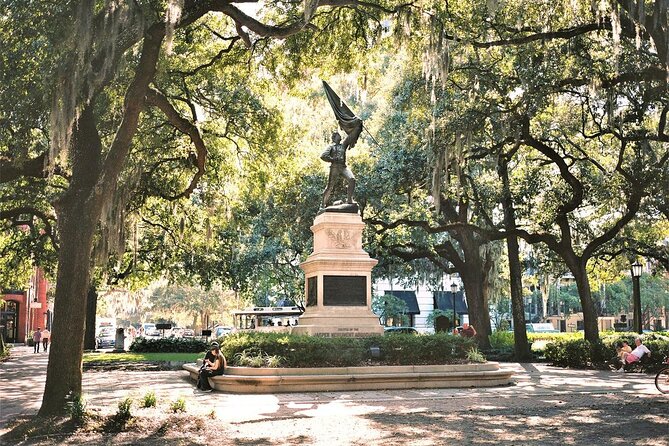
Chippewa Square is where Savannah starts feeling movie-famous fast. This stop is centered on the spot where Forrest Gump sat with his box of chocolates while waiting for the bus. It’s a quick moment, but it works because it’s specific. You’re not just hearing that Savannah appeared in film; you’re standing at the exact kind of “this looks like the scene” location.
You’ll also catch a fun correction: the monument in the center of Chippewa Square is General James Oglethorpe, not Captain Morgan. The resemblance is apparently so close that it’s easy to mix up. Savannah even leans into practical humor with-to-go cups, so the guide’s comparison lands.
The value here is interpretation. You’ll understand who Oglethorpe was and what his monument represents. That matters, because once you know what you’re seeing, you start noticing similar symbolism across the city’s squares.
Sorrel Weed House: Gray Brick Wall, Fingerprints, and a Haunted Reputation
Next, you’ll pass the Old Sorrel Weed House Museum & Tours. It’s known as one of the most haunted homes in Savannah. You won’t spend a long chunk of time here, but you do get the kind of details that make a “passing stop” memorable.
Pay attention to the Savannah gray brick wall around the courtyard. You’ll hear why the wall exists, and you’ll also get the explanation behind the fingerprints in the brick—plus the question of where that brick came from. That’s the sort of origin trivia that turns architecture into something you can actually picture.
If you like stories that blend folklore, craft, and local lore, this is a good stop. If you hate anything spooky, you can still enjoy it as an architectural and construction puzzle, because the focus isn’t only ghost talk.
You can also read our reviews of more private tours in Savannah



Madison Square: Siege of Savannah and Revolutionary Hard Edges
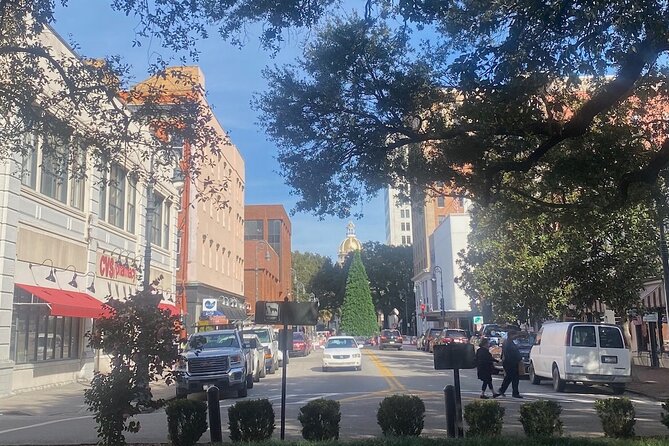
At Madison Square, you get a harder historical beat. This is where one of the bloodiest battles during the American Revolution took place—the Siege of Savannah.
This stop works best if you’re willing to hold two ideas at once: today it’s a square you can pass through and enjoy, but long ago it was a conflict zone. A good guide keeps that tension visible, so you don’t miss what the ground is saying.
Since the stop is about 10 minutes, you won’t get a textbook lecture. You’ll get the core facts and the significance, which is exactly what you want on a walking tour. Save the deep military study for a dedicated history tour, and let this one give you bearings.
Green-Meldrim House: Gothic Architecture and Sherman’s March to the Sea
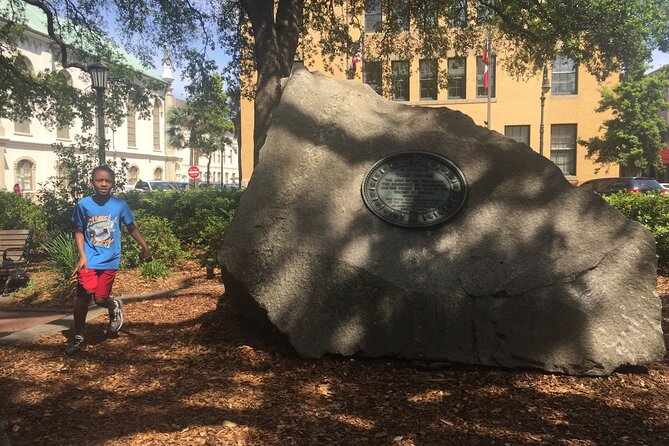
Green-Meldrim House is one of the most visually impressive stops on the walk. Completed in 1853, it’s described as a top example of Gothic architecture in the South. The cost detail helps you understand why it mattered: $93,000 at the time, or about $3.2 million in today’s money. That made it the most expensive home in Savannah during the 1800s.
This is also where the guide connects architecture to national events. The house served as Headquarters for General Sherman during his March to the Sea, when he occupied Savannah.
If you like when a place has layers, this is your stop. The same walls that signal wealth and design also held command and strategy. It’s a reminder that history isn’t one genre—it’s everything at once, just in different rooms.
SCAD’s Volunteer Guard Building Pass-By: A Quick Look at Repurposed Space
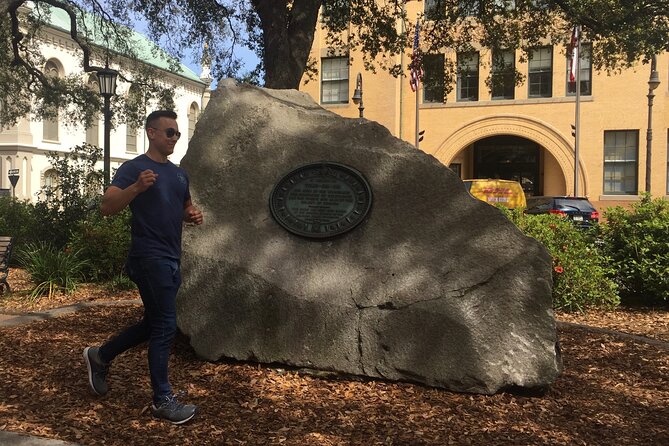
You’ll pass a building that originally served as the Savannah Volunteer Guard building, and it’s now owned by SCAD. This stop is short and deliberately observational: you’re not going deep, you’re getting the sense that Savannah’s older structures keep getting new jobs.
On a walking tour, these “pass-by” moments are useful. They help you see the city as a living system where historic fabric keeps functioning. If you love architecture and campus-adjacent urban texture, this quick stop adds flavor without stealing time.
Gryphon Tea Room: Lunch Break Energy in a Building with Medicine Cabinets
When the tour takes you to the Gryphon Tea Room area, it’s inside what’s referred to as the Shriners Building. The space includes a museum-like setting: it once was Solomon’s Apothecary. You can still see original mahogany cabinetry and cubbies used to store medicines.
And yes, this is also a place to eat or relax. The Gryphon Tea Room is a favorite stop for tea, lunch, dinner, or simply winding down during the walk.
This is one of those practical moments I genuinely value on a city walking tour. Savannah can be hot and humid, and tea rooms give you a soft landing. Even if you don’t sit for a long time, the option changes the feeling of the tour from “march onward” into “pace yourself.”
Mercer Williams House Museum: Midnight in the Garden of Good & Evil
One of the main reasons people pick this tour is Mercer Williams House Museum. It’s the house made famous by John Berendt’s book Midnight in the Garden of Good & Evil. The story centers on Jim Williams, who purchased the home in 1969, and the shooting involving his assistant, Danny, in 1981.
The book came out in 1993 and became a huge bestseller, staying on the New York best seller list for 216 weeks—longer than any book in history, according to the tour’s story. Later, the movie release helped put Savannah firmly on the tourism map.
Here’s the key advice built right into the tour vibe: if you can, read the book or at least watch the movie before you arrive. You’ll catch more of the references because the guide’s narration connects real location to real plot.
At this stop, you get a satisfying payoff. You’re not just chasing filming locations. You’re connecting setting to story, and that makes Savannah’s charm feel more human and specific.
Armstrong House: Armstrong-Kessler WOW Factor, But No Inside Access
The Armstrong House, now known as the Armstrong-Kessler house, is a different kind of stop. The guide will share the home’s history and who lives there today. It’s described as a 26,000+ square foot private home, and the tour makes a point that this is the one house in Savannah where people often pause with a visible wow reaction.
Important: you won’t tour inside. It’s a private residence and not open for tours.
Still, this is a useful stop because exterior views can tell you a lot—scale, style, and the kind of wealth and craft that shaped the city. If you like architecture and you don’t mind standing outside admiring, you’ll enjoy this moment.
Forsyth Park Finale: The Fountain That Started as a France Mail Order
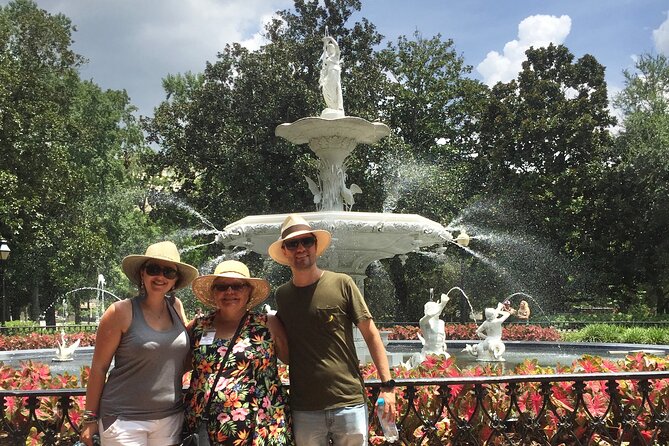
The walk ends at Forsyth Park, specifically at the fountain. Forsyth Park began in 1848 as 10 acres; today it covers 30 acres. The guide frames it as the city’s central park, enjoyed by both young and old.
Then comes the crowning jewel: the fountain. Most people notice the fountain and move on, but you’ll learn a detail that makes it even more interesting—the fountain was a catalog mail order from France and installed in 1858.
That little fact changes the whole vibe. Instead of assuming Savannah’s famous centerpiece had a local, handmade origin, you see it as part of a global flow of goods and taste. And of course, you’ll want your picture taken here, because the fountain is the visual finish line of the whole tour.
Pace, Comfort Stops, and How to Plan Around Weather
This is a walking tour, about 2 hours, with an easy-to-moderate approach. The distance is around 1 mile, and you’ll have benches along the way, which helps if you want a breather.
Savannah weather can be a factor, especially in summer when it’s hot and humid. Bring a bottle of water, and consider an umbrella. The tour operates in rain or shine, so you should dress for the day you’re actually getting, not the forecast you hoped for.
One more practical note: the tour is private, meaning only your group participates. That’s great for asking questions and steering the focus, but it also means group comfort matters. If you’re more than just a couple people, position yourselves so you can hear the guide clearly.
Customization Options: Civil War Focus and Built-In Food Breaks
A real strength of this tour is flexibility. You can customize topics, including Civil War history if that’s your priority. That matters because Savannah’s historic district can turn into a long list of facts. Customizing keeps the narration tied to what you personally want.
The tour also includes a stop for coffee and snacks along the way. It’s not just about comfort; it keeps energy stable. When you’re walking and listening for a couple of hours, a small food break can make the difference between enjoying the details and rushing past them.
Guides: Expect Fun and Clear Storytelling (Especially When You Can Hear Them)
This company’s guide talent shows up in the kinds of comments people make. Rose is described as awesome—knowledgeable and fun—with a pace that feels right for a private morning tour. Crystal is also singled out as extremely knowledgeable, covering what you want to know, and is praised for being the best among the guides people compared during their trip.
The good news: those names show the tour can deliver both facts and personality. The caution: audio matters. If you ever feel like the guide is speaking too softly, gently adjust your position and ask for louder delivery. It’s a small fix that protects the whole experience.
Should You Book This Private Savannah Walking Tour?
Book it if you want a high-impact overview of historic Savannah that still includes story-level details. This is especially worth it if you care about the connection between place and pop culture—Forrest Gump bench energy, plus Mercer Williams House and Midnight in the Garden of Good & Evil.
Skip it only if you want lots of inside-the-building museum time. This walk is built around exterior viewing and short storytelling stops, with one major museum stop paced for walking, not a long indoor session. If you’re hoping for deep, ticketed exhibits at every stop, you may need to pair it with additional museum time on your own.
If you’re planning a first visit and want to leave with a clear mental map—squares, symbols, key people, and that Forsyth Park fountain photo—this tour is a strong match.
FAQ
How long is the Savannah private walking tour?
It’s about 2 hours.
Where does the tour start and end?
It starts at Wright Square and ends at the fountain in Forsyth Park.
Is the tour private?
Yes. Only your group participates.
Is the tour offered in English?
Yes, it’s offered in English.
Do you go inside the Juliette Gordon Low Birthplace house?
No. You admire it from the outside.
Are there admission tickets at the stops?
The tour lists admission tickets as free for the stops shown, and Armstrong House admission is noted as not included. You’ll still be viewing most places from outside.
What should I bring for walking in Savannah?
Comfortable walking shoes, and if weather looks hot or rainy, bring water and consider an umbrella. The tour operates rain or shine. Service animals are allowed.