REVIEW · SAVANNAH
Heart of Savannah History Walking Tour – 2hr
Book on Viator →Operated by Explore Savannah · Bookable on Viator
Savannah’s squares tell stories fast. In this 2-hour walk, you’ll get an easy orientation through the historic district, and I really like how the guide connects monuments to people and events (hello Tomochichi, Oglethorpe, and Civil War-era details). The main drawback to plan for: it is still real walking, so bring water and expect a steady pace in warm weather.
What makes this tour a good choice is the mix of big-name landmarks and the smaller, oddball details you’d miss on your own. You’ll finish at Forsyth Park Fountain for that classic photo moment, and most stops are quick looks from the sidewalk (so you’re not burning time in lines). The group stays small (up to 30), and guides on recent departures included people like Rick Moss, Mark, Crystal, and Rose, who consistently bring humor and clear storytelling.
In This Review
- Key highlights worth circling
- Wright Square: where Savannah’s whole plan starts making sense
- Juliette Gordon Low: a quick stop with a big ripple effect
- Independent Presbyterian Church: steeples, fires, hurricanes, and a marriage
- Chippewa Square: the Forrest Gump moment meets real Savannah geography
- Sorrel Weed House area: gray brick walls and fingerprints
- Madison Square: Revolution conflict you can picture
- Green-Meldrim House: Gothic architecture with major Civil War ties
- The SCAD-owned Volunteer Guard building and the tea-room museum stop
- Midnight in the Garden: Mercer Williams House and Jim Williams
- Armstrong-Kessler House: the wow-stop you only see from the outside
- Forsyth Park: the grand finale and the fountain photo
- Pace, comfort, and group size: what your body should expect
- Is this the right Savannah tour for you?
- Should you book the Heart of Savannah History Walking Tour?
- FAQ
- How long is the Heart of Savannah History Walking Tour?
- Where does the tour start and end?
- Is this tour offered in English, and do I need a printed ticket?
- How much walking is involved?
- Are admissions included for museums or homes on the route?
- Does the tour run in bad weather?
- How big is the group?
- Is the tour suitable for most people?
- Are there morning or afternoon departures?
- Can I cancel for a full refund?
Key highlights worth circling

- Wright Square’s Gordon Monument: why Savannah was founded there, plus Tomochichi’s connection to the monument
- Juliette Gordon Low Birthplace Museum (from the outside): birthplace of the Girl Scouts founder, viewed without entering the home
- Chippewa Square’s Forrest Gump scene: the bus-stop moment tied to real Savannah geography
- Green-Meldrim House: Gothic architecture in the South, plus General Sherman’s headquarters during his March to the Sea
- Forsyth Park’s French mail-order fountain: a photo stop that feels like a payoff, not an afterthought
Wright Square: where Savannah’s whole plan starts making sense
Most tours begin with a landmark. This one starts with a reason. You meet in front of the Gordon Monument in Wright Square, on the north side of the square, and the guide sets the stage fast: why Savannah was founded here and what it meant to place a colony on a 40-foot bluff.
You also get the “how the city is laid out” angle. Savannah’s famous square system isn’t random—it’s part of the original design idea, and the guide points out what that design was trying to do. This is one of the best parts of the tour for first-timers because after two hours, you’ll know how to read the city instead of just staring at pretty buildings.
Then comes the name-dropping part that actually matters. You’ll learn about Tomochichi, the chief of the Yamacraw Indians, and why his burial is tied to the Gordon Monument. It’s the kind of detail you can walk right past later—so getting it early pays off.
You can also read our reviews of more walking tours in Savannah



Juliette Gordon Low: a quick stop with a big ripple effect
From Wright Square, the tour moves to the Juliette Gordon Low Birthplace Museum area. This is one of those “you can get the point in minutes” stops. You’ll admire the birthplace of Juliette Gordon Low, born October 31, 1860, founder of the Girl Scouts.
The important practical detail: you don’t go into the home. You see it from the outside and you move on, which keeps the tour focused and makes it flow smoothly for people who don’t want a long museum detour. If you like history that connects to everyday life, this is a nice tonal shift from military stories.
Independent Presbyterian Church: steeples, fires, hurricanes, and a marriage
Next up is the Independent Presbyterian Church area. The story here is not “one building survived forever.” It’s survival through rebuilding. The church was founded in 1755 on Ellis Square (originally Market Square), then destroyed by fire, rebuilt on Telfair Square, and destroyed again by a hurricane.
Today, you’re told where it sits now—on the corner of Bull St and Oglethorpe Ave—built in 1855. The guide also points out why the steeple is famous. And you’ll hear which U.S. president was married in the church in 1885. That’s the kind of fact that makes the architecture feel connected to national history, not just local streets.
It’s a short stop, but it shows you something valuable about Savannah: lots of what you see is layered. Some buildings you admire are here because people kept rebuilding after disaster.
Chippewa Square: the Forrest Gump moment meets real Savannah geography
If you came to Savannah partly for film-lore, Chippewa Square is your payoff. The guide directs your attention to where the famous Forrest Gump scene takes place—the spot where Forrest sat with his box of chocolates while waiting for the bus.
Then the guide corrects a common mix-up. The monument at the center of Chippewa Square is General James Oglethorpe, not Captain Morgan. The guide even acknowledges the visual confusion, but the point is clear: Savannah loves symbols, and knowing which symbol is which helps you enjoy the city more.
This is also a square where you can see how the city’s “past” is still in active use. You’re not touring a museum. You’re standing in the middle of daily Savannah life, and the history is sitting right there beside it.
Sorrel Weed House area: gray brick walls and fingerprints
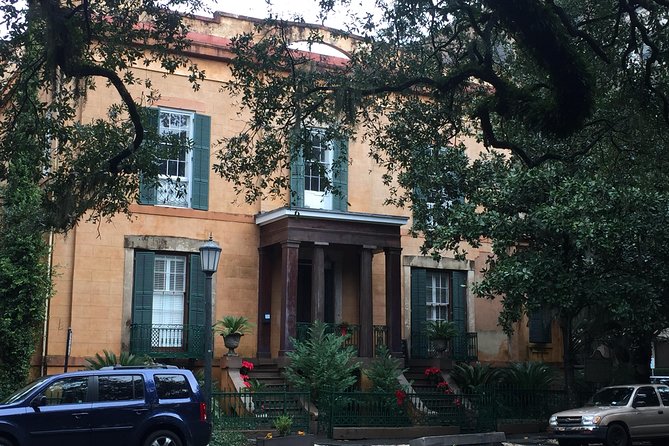
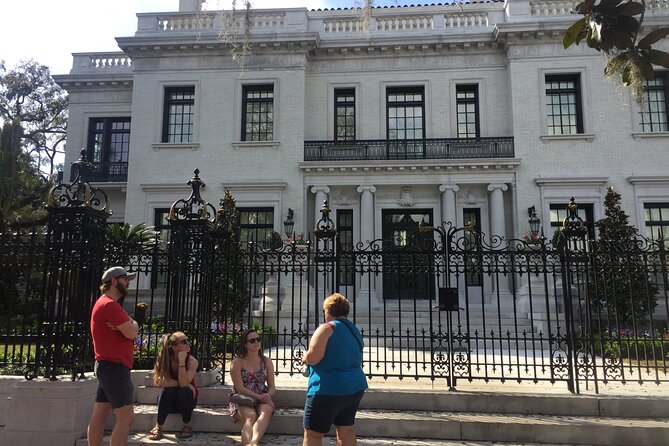
The tour passes by the Old Sorrel Weed House Museum & Tours, one of Savannah’s most haunted homes. Instead of sending you inside, the guide walks you through the details you can spot outside—like the gray brick wall that surrounds the courtyard.
One of the most intriguing bits is the story about the fingerprints in the brick. The guide explains how that feature ties to where the brick came from. Even if you’re not chasing ghost stories, this kind of behind-the-scenes physical detail is great because it changes how you see the architecture.
If you prefer strictly civic history over spooky lore, this stop may be slightly more “ghost-forward” in tone than you expected. Still, the craftsmanship and construction story helps it feel grounded rather than just campfire theater.
You can also read our reviews of more historical tours in Savannah




Madison Square: Revolution conflict you can picture
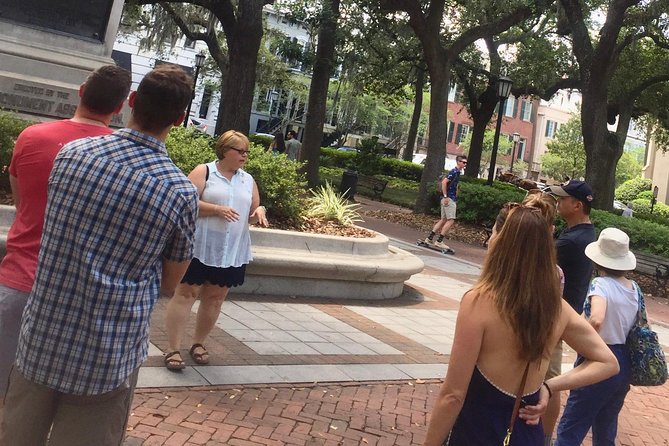
At Madison Square, the tour turns to war history. Here, the site was once the location for one of the bloodiest battles during the American Revolution, the Siege of Savannah.
This stop works best if you let the guide’s descriptions do their job. You’ll connect the quiet geometry of the square with the violence that happened in the area. The value isn’t that you’ll suddenly reenact the siege—it’s that the city stops feeling like it’s only about charm and starts feeling like it was a stage for real events.
It’s also a reminder to slow down for a minute. Savannah squares look easy to stroll through. This stop asks you to pause instead.
Green-Meldrim House: Gothic architecture with major Civil War ties
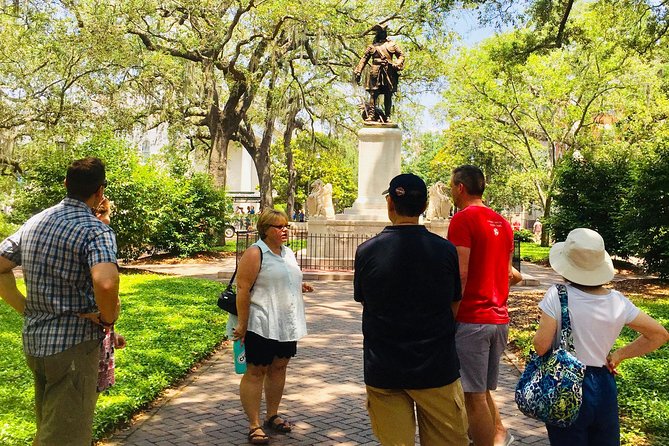
Now you’re headed to one of the tour’s most visually impressive story stops: the Green-Meldrim House. This home was completed in 1853 and is described as the finest example of Gothic architecture in the South.
You’ll hear the cost back then—$93,000—along with a modern equivalent figure the guide shares. That kind of number helps you understand what “grand” meant in the 1800s, not just how the home looks from the outside.
Then the historical moment: the house served as Headquarters for General Sherman during his March to the Sea, when he occupied Savannah. This is the kind of connection that makes the bricks and windows feel important. You’re seeing beauty and power in the same place.
The SCAD-owned Volunteer Guard building and the tea-room museum stop
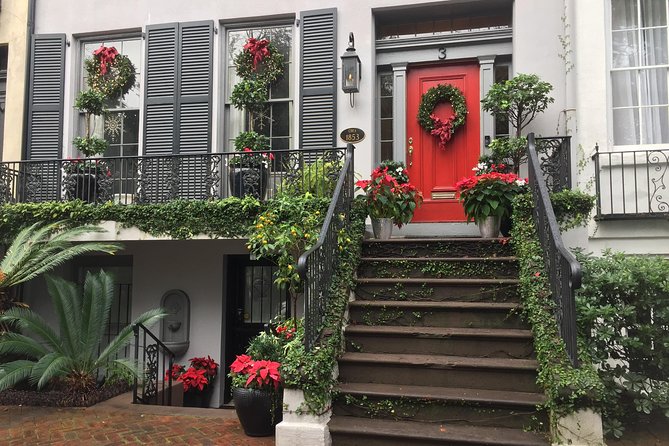
As you move along, the tour passes the building that was originally built and used as the Savannah Volunteer Guard building and is now owned by SCAD. You won’t linger here for long, but it’s a helpful bridge between different eras of Savannah life.
After that, you’ll be directed to the Shriner’s Building and the Gryphon Tea Room, which includes a museum inside. The guide explains that it used to be Solomon’s Apothecary and still has original mahogany cabinetry and cubbies used to store medicines.
This stop is especially useful if you like history that’s close to daily life. It’s not only about generals and battles—it’s also about what people bought, stored, and used when the city was young.
And yes, the guide makes a clear point: this is one of the favorite places to have lunch, dinner, or tea, so it can turn into a very natural plan for later in the day if you want a sit-down break.
Midnight in the Garden: Mercer Williams House and Jim Williams
Next comes the Mercer Williams house, made famous by the book Midnight in the Garden of Good & Evil written by John Berendt. You’ll learn this is based on the true story of Jim Williams, who purchased the home in 1969, and the shooting of his assistant Danny in 1981.
Then you get the modern cultural ripple effect: the book was released in 1993, and it stayed on a major New York best-seller list for 216 weeks. The movie release later helped put Savannah on the mainstream tourism map.
If you want the best experience here, do one small prep step: read the book or watch the movie before your visit. The tour guide’s logic is simple—knowing the story in advance makes the house feel like a character, not just a landmark.
Armstrong-Kessler House: the wow-stop you only see from the outside
The Armstrong house is now known as the Armstrong-Kessler house. The tour focuses on its history and who lives there today. You’ll get a sense of its size too—26,000+ square feet—and the guide emphasizes that this is the one home in town where people often stop and react.
Important practical note: it’s a private home and not open for tours, so you don’t go inside. The tour also notes that an admission ticket is not included for this stop. That’s fine because the goal here is the exterior impact plus context, not an interior museum visit.
This is a good moment to take a photo and just stare for a minute. Even if you’re not a architecture person, the scale usually does the job.
Forsyth Park: the grand finale and the fountain photo
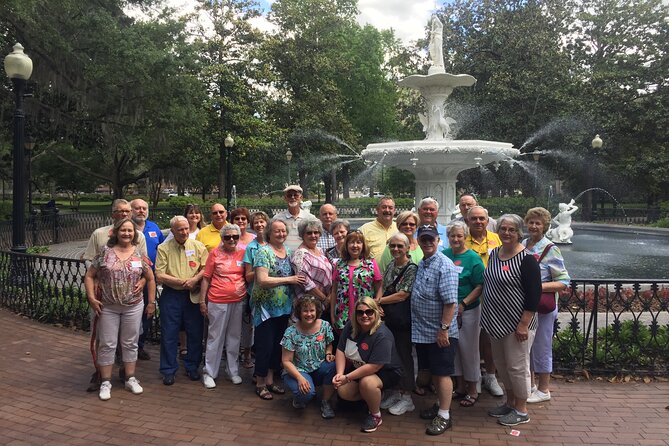
The tour ends at Forsyth Park, with the meeting point at Wright Square and the final stop at the Fountain area in Forsyth Park. The park started in 1848 with only 10 acres; it’s now 30 acres, and it’s easy to see why locals use it like a daily green room.
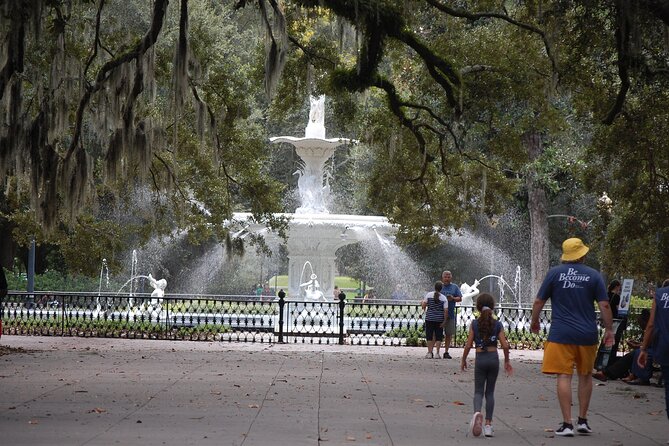
Then comes the crowning jewel: the Forsyth Park Fountain. You’ll get the story behind it—how the fountain was a catalog mail order from France and installed in 1858. That detail turns a familiar photo spot into something more interesting because it’s not just “old and pretty.” It’s a real example of how tastes and materials moved around the world.
The guide tells you to plan for a photo in front of the fountain. By the time you reach it, you’ll have enough context to enjoy the contrast: military and political stories back in the square, then open space and slow-down energy at the end.
Pace, comfort, and group size: what your body should expect
This is an easy-to-moderate walking tour. You’re looking at about 1 mile of walking, with benches along the route. It’s not a marathon, but it’s also not a sit-only tour. If you’re visiting in summer, the guide’s advice matches real life: hot and humid can hit hard, so bring water and plan for a slower rhythm.
The tour operates rain or shine. That’s helpful, but it also means you should pack for actual weather, not “nice forecast” optimism. An umbrella can save your day, especially around squares where wind can pick up.
The group maximum is 30, which helps keep the experience from turning into a shuffle. And the guide style on recent departures—people like Rick Moss, Mark, Crystal, and Rose—leans toward humor and storytelling, which tends to make the time fly.
One more practical point: Savannah can get noisy. If you’re sensitive to hearing, keep your position where you can see and hear the guide. If you can’t catch a detail, it’s worth asking them to repeat.
Is this the right Savannah tour for you?
I think this tour fits best if you want two things at the same time: an orientation through Savannah’s square system and stories that make those squares feel alive. If you’re the kind of person who likes landmarks but also wants context—who founded the colony, what disasters reshaped churches and homes, and how Civil War leaders used prominent buildings—this is a strong match.
It’s less ideal if you want a museum-heavy itinerary with long indoor time. Most stops are quick looks from the street, with only one “pass inside” style option mentioned as a tea-room museum you could enjoy separately.
Also consider your history taste. The tour includes Revolution, Civil War, and a fair dose of local character tales—plus some spooky elements around Sorrel Weed House. If you prefer strictly political and architectural facts, you may want to take the supernatural moments in stride.
Should you book the Heart of Savannah History Walking Tour?
Yes, you should book it if you’re trying to make sense of Savannah quickly and you like your history with a human voice. The route hits the big recognizable squares—Wright Square, Chippewa Square, Madison Square, and Forsyth Park—while also adding story-rich stops like the Mercer Williams House and the Green-Meldrim House.
If you’re short on time and want a plan that ends with a photo-ready finish at Forsyth Park Fountain, this one works well. Bring comfortable shoes, water for warm days, and an attitude for quick stories that connect the city’s architecture to real people.
FAQ
How long is the Heart of Savannah History Walking Tour?
The tour is about 2 hours.
Where does the tour start and end?
It starts in Wright Square in front of the Gordon Monument and ends at Forsyth Park, at the fountain.
Is this tour offered in English, and do I need a printed ticket?
The tour is offered in English and you’ll use a mobile ticket.
How much walking is involved?
It’s approximately 1 mile of walking, and there are benches along the way.
Are admissions included for museums or homes on the route?
Admission is free for many stops. Armstrong House is noted as not included, and the tour also specifies that the Armstrong-Kessler house is private and not open for tours.
Does the tour run in bad weather?
The tour operates rain or shine. In the event of severe weather, you’ll have the option to reschedule, with no refunds unless the tour is canceled by the provider.
How big is the group?
The tour has a maximum of 30 travelers.
Is the tour suitable for most people?
Most travelers can participate, and service animals are allowed.
Are there morning or afternoon departures?
Yes, you can choose from a morning or afternoon tour time.
Can I cancel for a full refund?
You can cancel up to 24 hours in advance for a full refund. Cancellation within 24 hours is not refunded.