REVIEW · SAVANNAH
Savannah Historic District Tour by The Wandering Historians
Book on Viator →Operated by Bonaventure, Historic Savannah, Low Country & Private with Shannon Scott Tours · Bookable on Viator
Savannah’s squares tell stories fast. This 2-hour walking tour gives you a clear feel for how Georgia’s first city was planned and why its architecture still hits so hard. I especially like the way the guide connects names, buildings, and street layout into one easy timeline, and I love how the main sights stay walkable without dragging you through long museum lines. One possible drawback: this is mostly focused on the past, so if you want lots of current scene tips or everyday neighborhood flavor, you may want to pair it with your own wandering.
What makes it work is the guide style. I found that when historians like Ken, Paschal/Pascal, and Janine take the lead, the pace stays upbeat, questions get welcomed, and the history doesn’t feel like a lecture.
You’ll start and end at Monterey Square (11 W Gordon St). Tours run in the morning or afternoon, the group stays small (max 30), and you’ll be on your feet the whole time—bring comfy shoes.
In This Review
- Key things to know before you go
- Walking Savannah’s square grid the right way
- Price and time: is $36.50 worth it?
- Johnson Square and the city’s first organized core
- Wright Square and the original founding-era links
- Chippewa Square: rowhouses, theaters, and Georgia’s creator
- Oglethorpe Monument to the Savannah Theater: public art as a guide
- The refresh and the street fronts: espresso, pub, and a Moorish-style bar
- Madison Square and the city’s big architectural mix
- A 119-foot steeple, Scottish ties, and a school building repurposed
- From William Jasper to Poetter Hall: military pride meets modern restoration
- Gryphon Tea Room and the Masonic temple interior feel
- Jones Street: Savannah’s most beautiful street moment
- Monterey Square, Mercer House, and the Midnight in the Garden of Good and Evil link
- Temple Mickve Israel: old Torah, Christian-styled space, and big-time religious history
- Pulaski Monument: the mystery the guide wants you to notice
- If you care about architecture, this walk hits the markers
- Who should book this tour
- Should you book the Savannah Historic District Tour?
Key things to know before you go
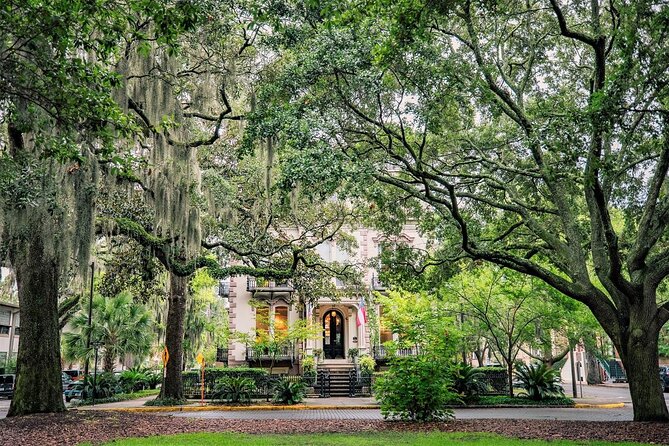
- A tight on-foot loop: you hit the big squares and landmark stops in about 2 hours.
- Historian narration with architectural focus: churches, steeples, and facades aren’t just pointed out—they’re explained.
- Small-group pacing: max 30 people, and the walking time tends to feel well managed.
- Mobile ticket convenience: you don’t need to hunt for paper when you arrive.
- Morning or afternoon options: you can fit it into a first-day orientation or a mid-trip reset.
- Primarily history-based: the emphasis is on origins, layout, and landmark stories.
Walking Savannah’s square grid the right way
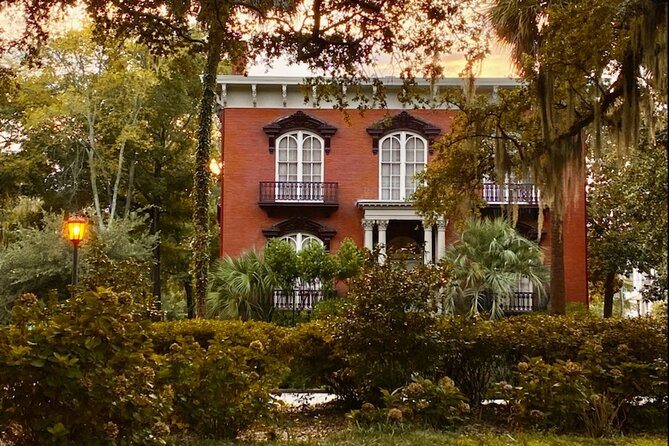
Savannah can feel like a maze at first—pretty, yes, but still a lot of streets and angles. This tour solves that problem fast by walking the square system instead of sending you in random directions. The historian guide frames what you’re seeing in plain language: why squares exist, how the city was organized, and why certain corners matter.
You also get a practical benefit: once you understand how the Bull Street corridor of squares works, planning the rest of your days gets easier. The walk keeps you within a short range of the starting point, so you’re not stuck far away if you decide to grab coffee, use a restroom, or reroute your afternoon.
And yes, you should expect real walking. It’s not a sit-and-stare tour, and comfortable shoes are a must.
You can also read our reviews of more historical tours in Savannah



Price and time: is $36.50 worth it?
At $36.50 per person for about 2 hours, you’re paying for three things: guided context, efficient routing, and a guide who can connect what you see to why it exists. In a city where many highlights are spread out, two hours with a thoughtful historian can save you hours of guesswork.
It’s not a deal if you’re looking for lots of modern dining, shopping, or “where to go tonight” recommendations. But if your goal is to understand Savannah’s layout and architecture quickly, this is a cost-effective way to get oriented without spending a day digging through standalone attractions.
One review-style theme you’ll want to note: you’re paying for story and structure, not a long series of museum interiors.
Johnson Square and the city’s first organized core
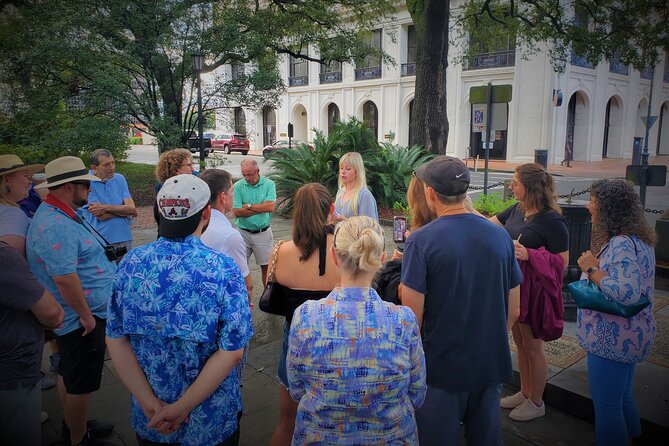
Johnson Square is where the tour mindset clicks into place. This is Savannah at its earliest scale: the city’s largest square, tied to the colony’s organization starting in 1733 and still central to daily life. The guide focuses on how this square became a hub for culture and commerce, not just a postcard stop.
Within this stop area, you’ll hear about City Hall and local landmarks, plus burial references connected to important figures (including Nathanael Greene, his son George Washington Greene, and others mentioned by the guide). You’ll also see the Church of England in its longstanding role in worship here since 1733, described as a Classic Greek Revival masterwork at the southeast corner.
Then the tour points out the former 1799 City Exchange, now marked by the building erected in 1906, with the 22-carat gold dome that still signals civic power. Even if you’ve only walked by city buildings before, this is the moment the guide helps you read what you’re looking at.
One consideration: this part moves fast. It’s short, so if you want deeper backstory at each spot, come prepared with a few questions.
Wright Square and the original founding-era links
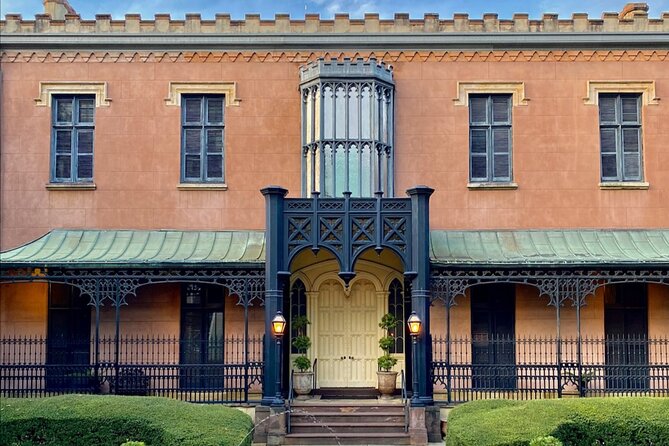
Next comes Wright Square, one of the original squares laid out during James Oglethorpe’s founding period. The tour treats this square like a living document: you’re told how it once held a first burying ground, courthouse, jail, and even the eventual burial site of Tomochichi, the Indian king.
The point isn’t just that history happened here. It’s that Savannah’s founders designed a city where government, community, and memory were physically close. That’s why the squares feel meaningful rather than decorative.
This is also where you get a taste of why the tour route is built around walking life. The guide’s narration tends to connect what you see—brick, facades, churches, monuments—to what the city was trying to do.
Chippewa Square: rowhouses, theaters, and Georgia’s creator
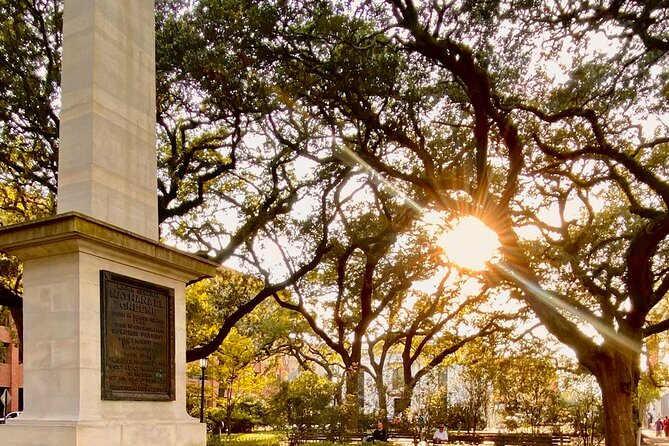
Chippewa Square keeps the rhythm going. Here you’ll get a mix of architectural eras—Colonial and Victorian rowhouses, churches, inns, pubs, and coffeehouses—plus major civic anchors like the Savannah Theater and the monument of Georgia’s founder, Oglethorpe.
Oglethorpe’s statue is credited to Daniel Chester French, the sculptor behind the famous Lincoln Memorial statue in Washington. The tour uses that connection to make the public art feel less random and more intentional: Savannah’s monuments are part of the same story as its planning.
You’ll also pause for another inn-and-boarding-house reference tied to an early woman-run operation that remains one of Savannah’s time-honored inns. This is the kind of detail that helps you see the city as real people living and working—not just preserved buildings.






Oglethorpe Monument to the Savannah Theater: public art as a guide
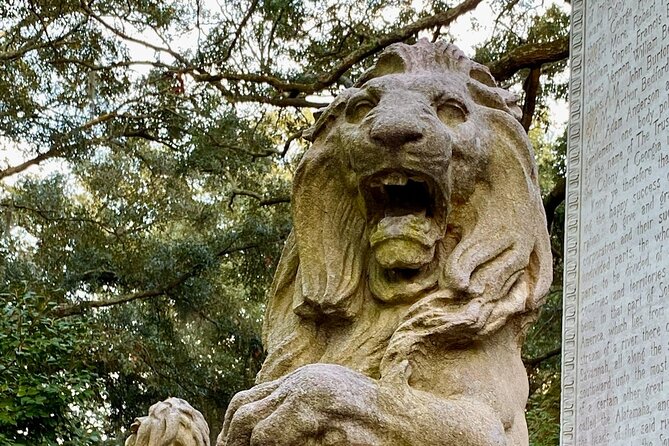
At James Oglethorpe Monument, the tour notes something you’ll likely remember: Daniel Chester French described it as his finest work, and the statue is often called lifesize even though it’s actually over 9 feet in reality. That’s a small fact, but it works because it helps you visualize how massive public figures were meant to feel in the street.
From there, you move to the Savannah Theater. The guide emphasizes its status as America’s oldest continually operating theater (even with changes from fires). You’ll hear that it hosted figures like Oscar Wilde lectures, the Booth family, and performances referenced by the guide, including Cesar Romero early as a child.
If you like history that includes culture—stage, speech, public life—this stop pays off.
The refresh and the street fronts: espresso, pub, and a Moorish-style bar
A good walking tour knows you need breaks that don’t derail momentum. The tour includes short stops where you can reset.
- The Gallery Espresso is where you may grab a coffee and, if needed, use facilities—quick stop energy.
- Then you’ll see a pub facade with an exterior London-style phonebooth detail, matching an English-town vibe. It’s described as founded by a former chef from Kenny Rogers, and it stays popular.
After that, the tour turns to Artillery Bar. This is another “how to read a building” moment: it started as a Victorian stable for Arabian horses, and today it’s a Moorish-inspired structure with rounded glass corners and a terra-cotta facade. The guide also points out that Henry Ford opened a showroom here in 1905; now it’s a cocktail bar.
The takeaway is simple: Savannah repurposes buildings instead of freezing them in time. The tour helps you see that as a strength, not a compromise.
Madison Square and the city’s big architectural mix
Madison Square gets the “zoom out” treatment. The guide frames it as part of the five-square backbone of the tour route, and it’s presented as a main axis of Savannah’s walking life with churches, shops, cafes, and architectural variety.
You’ll also connect the dots to design and education because the Savannah College of Art & Design (SCAD) was founded here in 1976 inside The Chatham Artillery, now tied to the Madison Square area. Even if you don’t go into SCAD buildings, hearing that SCAD started in this setting makes the campus story feel grounded in Savannah’s structures.
Two quick architecture-focused stops help you understand the city’s style language:
- A Greek Revival house associated with the Sorrel & Weed families is pointed out as one of the finest examples in America, and the guide shares a modern paranormal tie-in involving a Ghost Hunters episode connected to their company founder.
- The Eliza Jewett Home is connected to a popular bookseller/tea house spot, with the guide tying it back to an empire-level woman’s story.
You won’t be sitting on this tour with long explanations. Instead, you’re seeing enough variety that your brain starts sorting Savannah into “what time period is this” and “what kind of power story is this?”
A 119-foot steeple, Scottish ties, and a school building repurposed
One of the most memorable visual anchors is the 119-foot cast iron steeple, described by the guide as the highest point in the city. It’s tied to an 1819 architectural wonder built by John Holden Greene and framed as one of Savannah’s religious epicenters, including references to Scottish heritage.
The guide also notes that Woodrow Wilson married in the courtyard connected to this place. That’s a distinctive detail because it links Savannah’s sacred architecture to national history.
Nearby, you’ll be directed to The Chatham Boys Academy, originally built as an elite school for boys. The guide points out the sculptural frieze work credited to sculptor John Walz, connected to Gettysburg Battlefield and Bonaventure Cemetery, and explains that the space now serves as the Board of Education for Chatham County.
This section is why I like this tour for first-timers: Savannah’s buildings aren’t just pretty. They’re civic machines, education engines, worship centers, and power statements.
From William Jasper to Poetter Hall: military pride meets modern restoration
At William Jasper Monument, the guide focuses on Revolutionary War hero Seargent William Jasper, described as a South Carolinian plantation owner who gave his life defending Savannah. The stop is short, but it carries emotional weight because it’s a portrait of individual sacrifice placed right where people walk.
Then you move to Poetter Hall, connected to Chatham Artillery barracks history. The tour explains that in 1976, two educators from Atlanta founded what became SCAD and that they later restored over 100 buildings in Savannah, with campuses extending as far as Lacoste, France. Even without stepping inside, hearing that scale of restoration helps you understand why so much of Savannah looks the way it does today.
Gryphon Tea Room and the Masonic temple interior feel
A big part of the tour’s charm is how it changes setting. At Gryphon Tea Room, you’ll be told it sits inside a massive Roman-styled Scottish Rite Masonic Temple, now owned by SCAD. The guide shares that the tea room draws on Victorian authenticity and is linked to Savannah’s memory of Solomon’s Drugstore, including references to original interior derivations.
This is one of those stops where the guide is less about facts in a list and more about helping you notice style details: proportions, materials, and the way the room feels preserved.
Jones Street: Savannah’s most beautiful street moment
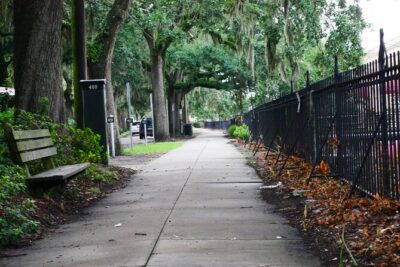
At Jones Street, the tour shifts into “walk slowly and look down” mode. You’ll hear that the street keeps original brick and asphalt brick streets and that the Jones Street corridor east to west is one of the best examples of rowhouses on one block.
The guide also frames this as how communal Savannah living feels—homes in a continuous, shared streetscape rather than scattered landmarks. For many people, this is the most Instagram-friendly stretch of the day, but it’s also one of the best for understanding how neighborhoods functioned.
Bring patience for uneven pavement and plan your photos quickly so you don’t hold up the group.
Monterey Square, Mercer House, and the Midnight in the Garden of Good and Evil link
At Monterey Square, you get the European-quiet vibe locals associate with the area. The guide highlights tall rowhouses, Barbados-style references, and the resting place story tied to Count Casimir Pulaski in 1779. You’ll also hear that Jeff Davis hid out here during the Civil War, and that preservation figures Lee & Emma Adler lived in the area until their recent deaths.
No tour like this stays complete without mentioning the Mercer House connected to Midnight in the Garden of Good and Evil. The guide shares that the home sits near Temple Mickve Israel and that the Mercer House story includes:
- an 1860 mansion built by the great-grandson of General Hugh Mercer,
- later use as a Masonic Temple,
- then private home of antiques dealer Jim Williams for 20 years,
- and the 1981 tragic killing that became the basis for the novel and the New York Times bestseller referenced by the guide.
You’ll also be told this tour can talk about the case in a personal way rather than only repeating plot beats. That matters if you like context and nuance instead of cliff notes.
Temple Mickve Israel: old Torah, Christian-styled space, and big-time religious history
The tour pauses near Temple Mickve Israel and emphasizes something you won’t expect in the region: a Jewish community with deep roots this far south. The guide notes Savannah claims America’s 3rd oldest, and it includes the fact that the congregation attends a Christian-styled building.
The most striking detail shared is that the Temple holds the oldest Torah in the world, said to be over 1100 years old. The guide also gives an explanation for why this history unfolded, framed as closer to the real story than a simple parable.
This is a powerful stop because it broadens your sense of who shaped Savannah, not just who built its squares.
Pulaski Monument: the mystery the guide wants you to notice
At Pulaski Monument, the narration becomes part mystery. The guide credits Latvian sculptor R.E. Launitz for the monument and explains there was controversy around which remains were actually Pulaski’s.
The lesson here is about civic memory and uncertainty—how cities handle messy facts in the center of public view. Even if you don’t know the full story beforehand, the tour points you to why this debate stuck and why it still matters in public history.
If you care about architecture, this walk hits the markers
I like that the tour makes architecture readable. You’ll encounter Classic Greek Revival details near the Church of England, Gothic Revival notes tied to a major school building area and other linked structures, and even Moorish-inspired design at Artillery Bar. When you see the variety laid out in one route, the styles stop being random facts and start sounding like a timeline of who had power and what they wanted to project.
And the guide keeps it moving: enough time to look, short enough to avoid fatigue.
Who should book this tour
Book it if you:
- want a fast orientation to Savannah’s square plan,
- care about how architecture connects to power and daily life,
- want a guided way to place monuments, churches, and theaters into a single story.
Consider skipping or pairing it if you:
- are mainly looking for modern restaurant, nightlife, or shopping guidance,
- hate walking-heavy tours or want lots of indoor time.
Should you book the Savannah Historic District Tour?
Yes, if your goal is to understand Savannah quickly and walk the squares with a historian’s framing. The $36.50 price makes sense for a focused 2-hour route that covers the core landmarks and architectural beats without wasting time in long lines.
If you’re expecting a tour that centers present-day neighborhoods or lots of casual local lifestyle tips, you may find the emphasis is more past-and-building than “what to do tonight.” In that case, book it early in your trip, then let the rest of your day follow your own curiosity.